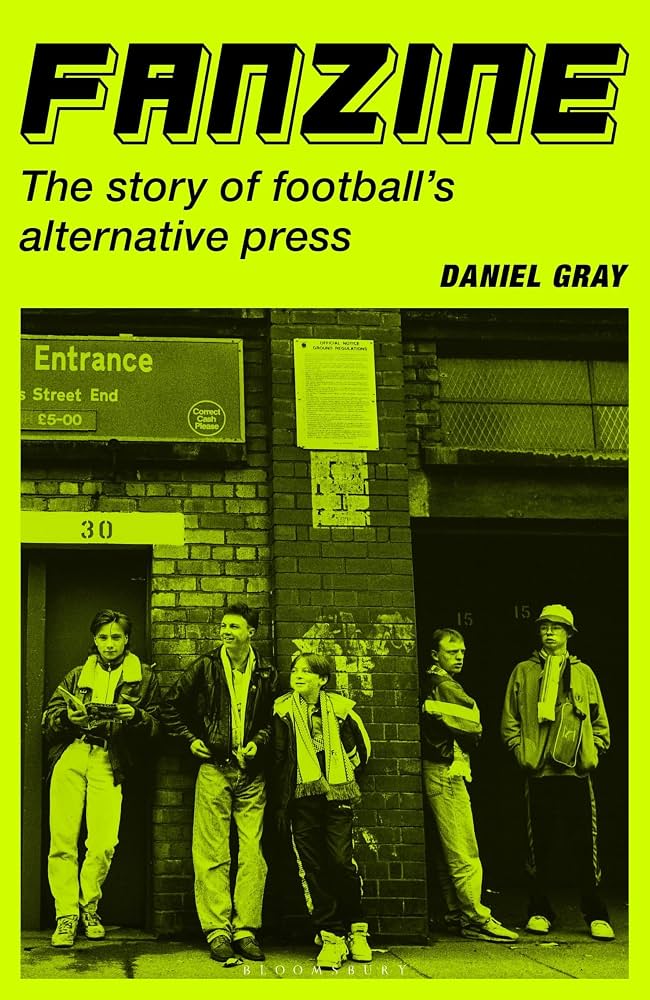
Daniel Gray’s new book explores the fanzine phenomenon during the peak years of the 1980s and 1990s. It offers an alternative history of football during a troubled and transformational time as witnessed by supporters.
Gray neatly summarises the birth of fanzines. “They sprang from a time of despotic club chairmen and intransigent administrators of the game who cared not a fig for the supporters and the derelict conditions in which they watched football. During that era, supporters were policed as if they were all potential terrorists. Stadiums that fans said were death traps proved to be so.”
For many, by the mid-1980s the simple act of going to the match was often an unpleasant undertaking, yet their devotion to football meant they still went along to the games.
It was a time of dreadful treatment of football fans by the Police. When violent incidents occurred, what happened next worked to a standard formula. News outlets would often embellish and hyperbolise events. Politicians would then scramble to be the most hardline in their responses. Journalists fanned the flames and the police felt emboldened in their draconian attitudes to matchdays.
Fanzines came from a belief that football fans deserved something better than the negative national media. Graham Ennis of Everton fanzine ‘When Skies Are Grey’ recalls the massive surge in Fanzines. “Before, the fan’s voice was completely unheard and there was no outlet for it whatsoever. It seems really odd in today’s game where fans’ voices are absolutely everywhere.”
Nationally, the Guardian’s Stephen Brierley spoke for many when, in February 1989, he described fanzines as ‘one of the delights of soccer in the past few years, glorious pulsating beacons of irreverence, wit and real information’.
Later that year in the Independent, Patrick Barclay gave deep praise for the way fanzines had eloquently struck back against the linking of football with hooliganism and inspired a vast improvement in literature about the game.
In 1988/89 the Inflatables craze showed the public that that fun-loving football fans were not hooligans. “Some supporters chose objects that pertained to their clubs or local areas – West Ham United fans brought hammers, Brentford bees, Hull City tigers, Norwich canaries and Grimsby fish. The Bury club shop stocked 3000 inflatable black puddings while followers of Lancastrian neighbours Wigan Athletic waved baked bean tins, a nod to the local Heinz factory.”
The new fanzines were especially adept at co-ordinating protest against the schemes of club owners. The threat of club mergers was rife at the time, and some fanzines ran successful campaigns against club mergers.
“Even if you’re on the dole,” declared an encouraging ‘Off the Ball’ article, “you can get a typewriter for a couple of quid a week through a Mail Order catalogue.’’ Other requirements for starting a fanzine included a stapler, glue and a “stencil (less than a quid) for headlines” although “about £10 worth of Letraset gives you the opportunity to make far more striking and varied” versions. It should be remembered, though, continued the piece, that “what the mag says is more important than how it looks.’’
Fanzines gave people an opportunity to write for the first time. Jonny Owen now an actor, producer and radio presenter said, “…the utter thrill of seeing one’s own words in print across a fanzine’s pages was known to thousands. This democracy was simply unknown in the traditional media.”
Throughout the book Gray is nostalgic for the simpler days when xeroxed pages and irreverent humour were the norm before the technological change that brought social media and all that entails.
He successfully takes us back to the heyday of fanzines; recounting the major events of the period and achieves this with some style and wit. He has an affinity with the alternative and independent and he revels in stories about the different fanzines.
‘Fanzine’ is a superb account of what we were thinking, wearing, eating and saying 40 years ago, it is a people’s history of football, and of Britain.
Fanzine: The Story of Football’s Alternative Press by Daniel Gray. Published by Bloomsbury Sport. Price £19.00.
A version of this review first appeared in the November/December 2026 edition of Late Tackle magazine.

 Latics News 24/7
